
- Bugging out basics
- Bug out locations:
- Where to stay:
- Safe movement
- Hiding in UK
- Hunkering down
- Evacuation tips:
- Bug in or out?
Bugging out basics
- Examples of why it may be too dangerous to stay put are shops not being replenished, looting, weather your home cannot save you from or emergency services overwhelmed.
- Have multiple routes. With knowhow, preparation and training you could well walk, drive, sail or fly to freedom cutting across land, rivers or even to France, although during the 2020 covid pandemic the army used civilian airports. Think, if you were on the TV show Hunted how would you get across country? Consider lessons in flying and boating in case you need to commander vessels.
- Take ID, insurance and title documents with you.
Bug out locations:
- Arrange bug out locations in different directions and distances, which could, for example, be a forest, cabin, second home, friend’s house or even another country.
- Journeys that rely on roads not being jammed need backup locations on the way.
- Routes should ideally have supplies previously stashed along the way.
- Locations should ideally have duplication of what you have benefitted from at home, failing that you could load up a car with multiple INCH bags, or if on foot you are limited to dragging one INCH bag of about 1201 and for long distances you will struggle to carry more than a 60l bug out bag, after a few miles you will wish it was only a 30l get home bag, in fact if you are out shape then after a few miles you will wish the 30l bug out backpack was a 15l get home daysack. This is why stocking up bug out locations with heavy consumables like fuel, water and food is worth it if you can afford the duplication. As a rule of thumb, expect a bag to weigh 250g per litre; a penchant for water and gadgets will push this up to more like 350g per litre, whereas relying on skills and lightweight gear can easily whittle it down to 200g per litre. Ways to hack back on weight include a bivvy instead of a tarp, a mug instead of a flask, a knife instead of a multitool, a lighter instead of a fire kit, a headtorch instead of a tactical torch, Rab Phantom waterproofs instead of a poncho.
- As you cannot be sure your locations have not been compromised, you always have to carry at least a bugout bag of survival items so you are not dead if your comfort items have been raided.
Where to stay:
- Depending how long the disaster lasts, you may need to stay in a rural area or bug out to somewhere probably suburban – with a kitchen garden, well, sewage facility and a group of you to defend the perimeter, ideally hundreds of miles from an urban area or line of drift – which is sadly impossible in the UK.
- Failing that, you may need to bug in with:
- weapons,
- fuel,
- off-grid comms,
- medicines,
- cash and barterables,
- tools,
- repair kit,
- hygiene and cleaning materials,
- heirloom seeds,
- survival and NBC gear,
- batteries,
- chargers,
- generator, and
- food and water
that you would store or INCH-bag to any hideout, to try to hold out in an increasingly untenable urban area.
- You may simply need to bug in at work overnight while weather clears, in which case, although you should always have your EDC and get home bags with you, you could do with an overnight camp kit in your locker to the extent it has different gear. This might be a torch, radio, books to read, snacks, water and toiletries, so the main difference will be it is for freshening up and passing the time rather than survival.
- If travelling abroad, consider how you will get home if transport is disrupted by natural disaster, civil war or epidemic, and how you will stay put if you cannot. FCO recommends signing up to their travel alerts.
Safe movement
- The urban movement procedure, in an at least semi combat scenario in a high threat situation, is:
- think,
- hide,
- first aid,
- go grey man,
- update family,
- lock down hideout,
- take water,
- check what tools you have,
- sleep,
- sneak to next hideout,
- eat,
- repeat.
- Your tactical movement by stealth with camo varies from walking main roads for speed in normal clothes with no need for hiding, security and first aid for an isolated transport breakdown, to trauma kit, lockdowns, camo and crawling in war.
- Going grey man assumes you are on the way to civil war, martial law or rule of law is breaking down.
- The standard steps are:
- plan,
- hide,
- treat,
- sanitise,
- camo,
- comms,
- secure,
- drink,
- check tools,
- rest,
- navigate to friendly neighbourhoods in dark or bad weather around obstacles via woodland or paths depending if people are a threat,
- consume, and if necessary source, food,
- repeat.
- It is not just a mad rush to get home to family, but a project to get there healthy and ensure they are there waiting.
- Bear in mind that cities are prime targets for WMD, where diagnosis will take too long and there will be too many casualties for authorities to help.
- Stop to:
- consider your strategy,
- seek shelter,
- deal with injuries or contamination (remove unstuck clothing, soak or brush, rinse),
- strip off anything that makes you stand out,
- radio family to check in,
- ensure you are somewhere safe for a kip,
- have a drink,
- check your gear so you know what you have and stash anything you will not need,
- have a kip,
- then move whilst avoiding routes with dangerous people.
- Before moving, consider:
- land,
- weather,
- how long you want to take,
- who is where,
- what do they want and
- what can they do?
- The demographic may eventually become haves and have nots.
- Eventually an army or civilians may start roadblocks, confiscation, internment or curfews. These would be a belligerent enemy invading force or an unconstitutional junta or criminals, either way they are at worst hostiles and at best obstacles, and certainly incompatible your survival even if they are not shooting at you, and by definition there will be no law to prohibit dealing with them using superior rations, shelter, local knowledge and cunning. By this stage transport lines and broadcasts may well be gone. Somebody may be trying to take out or rebuild energy, money, comms, medicine, transport and culture, possibly the same forces harassing you now. If such an army cannot reinstate utilities and security they will have no support.
- Keep hydrated but do not worry about food until day two.
- A hideout should be where nobody would go, with multiple escape routes, like a hedge, drain or building with lots of doors but only one easy approach.
- Patch yourself up for bleeds, breaks and burns.
- If you survive a nuke blast then burns and radiation or restricted medicines, food, water and shelter may get you later, but surprisingly glass splinters can bounce off and usually do not get inside the chest and even if they do probably will not kill you, and likewise for burst lungs, but you may have to contend with temporary blindness and deafness. You need to stay in shelter for up to a fortnight and should not pop out for food and water for a few days, and even then only for minutes in the first fortnight; you will not be going far in an NBC suit anyway even if you had one.
- For camouflage:
- Try to make your clothing and packs into blotches of shades of grey, darker for night, not all black if you fear night vision tech,
- hide tags and moral patches, and
- try to avoid displaying carabiners, webbing, molle and tactical gear;
- a grey man blends in and camo stands out a mile in urban areas and even in woods, so you may be better in innocuous plain browns and greens in case you happen across people – reversible clothing would be great.
- Get in touch with family to work out where you will meet and if you need to bug out or bug in when you arrive and estimate your progress and ETA.
- You probably will not have perimeter alarms in a get home bag but you might at least be able to hang a mug on a door handle or something as an early warning of intruders to your hideout.
- Drink ready for the journey and if necessary obtain and purify water.
- Get your bag ready to run before getting your head down.
- Grab sleep now as you never know when it will be safe to do so again.
- You should have got yourself trained in first aid, comms, water sourcing & purification and navigation before SHTF.
- Avoid playgrounds and parks, as they have excitable creatures frequenting them. Avoid gangs.
- Expect undesirables to change tactics over time. Do not underestimate how much adversaries will come at you with once they are hungry. Do not trust anyone or uniforms or lack of uniforms.
- In conflict, the city is partly your friend as probably nobody will have much firepower, time or men to persistently target you, and they are even less likely to control a big area, plus outside any collapsed areas you still have tunnels and basements and there are often air and sea options (as long as war has not broken out). But you could face no electricity so no lights or heating, and have to contend with fires or even firestorms and loss of landmarks, and have to battle ruins, toxic dust, chemical leaks, uncollected rubbish, disease, floods, sewage and rotting animals. Prefer grid street layouts as it is easier to predict where everyone is going.
- Streets may become kill zones meaning you have to breach walls.
- No gymnastics, just confident strolling like somebody with no valuable gear, or you acquire transport such as a cycle or car depending how much rule of law is left.
- Ideally hide survival kits in a wallet, pouch and in clothing so if you lose something like your bag in a robbery or an escape you still have something.
- Note resources and potentially cache some on the way. Industrial buildings may house chemicals for purification, fertiliser, pesticides, fuel, medicines and batteries. Others may house food, water and shelter gear.
- If you are worried about night vision being used on you then wear various shades of dark grey and hope there is still ambient light to degrade the equipment. Your natural night vision takes half an hour to get up to speed. In the dark you can see better slightly side-on.
- If moving through contested area do it at night with no torch, talking, scented toiletries, fires, smoking, insect repellent, shiny items on show or clanking objects. If you have to do it in daylight then disguise your gear with use of civilian clothes, bags, wallets and cache belts.
- To hear better open your mouth, and turn your head from side to side to trace sounds.
- Rehearse routes in night and day. This may have to be a family adventure as you would be away for several days if for example you commute into London.
- Find rest stops in advance.
- Get home bag:
- A get home bag needs food to eat on the move without cooking, so it is about snacks not stoves.
- Most people are not that fit, so carrying enough water is probably not going to happen, but everyone should carry water treatment gear like a bandana, purification tablets and a pocket filter or UV pen, plus fire starting gear such as a lighter and tinder.
- You will need comfortable clothes, hiking footwear and a space blanket.
- A first aid kit is ideal; expect bad feet and stomach.
- A multitool is worth considering.
- A map and compass are essential.
In event of attack: escape, hide, take cover, barricade yourself if not too dangerous to be trapped, call for backup.
Hiding in UK
- In Britain the two contenders for furthest spot from a road is 2.4 miles at Riggs Moor in Yorkshire Dales or 5 miles from a road at Hells Bottom on Glendhu Hill in Northern Pennines in England, or 5.7 miles from a road at Fionn Lock in Scotland, or 3 miles from Glynatawe in the Black Mountains in Brecon Beacons in Wales.
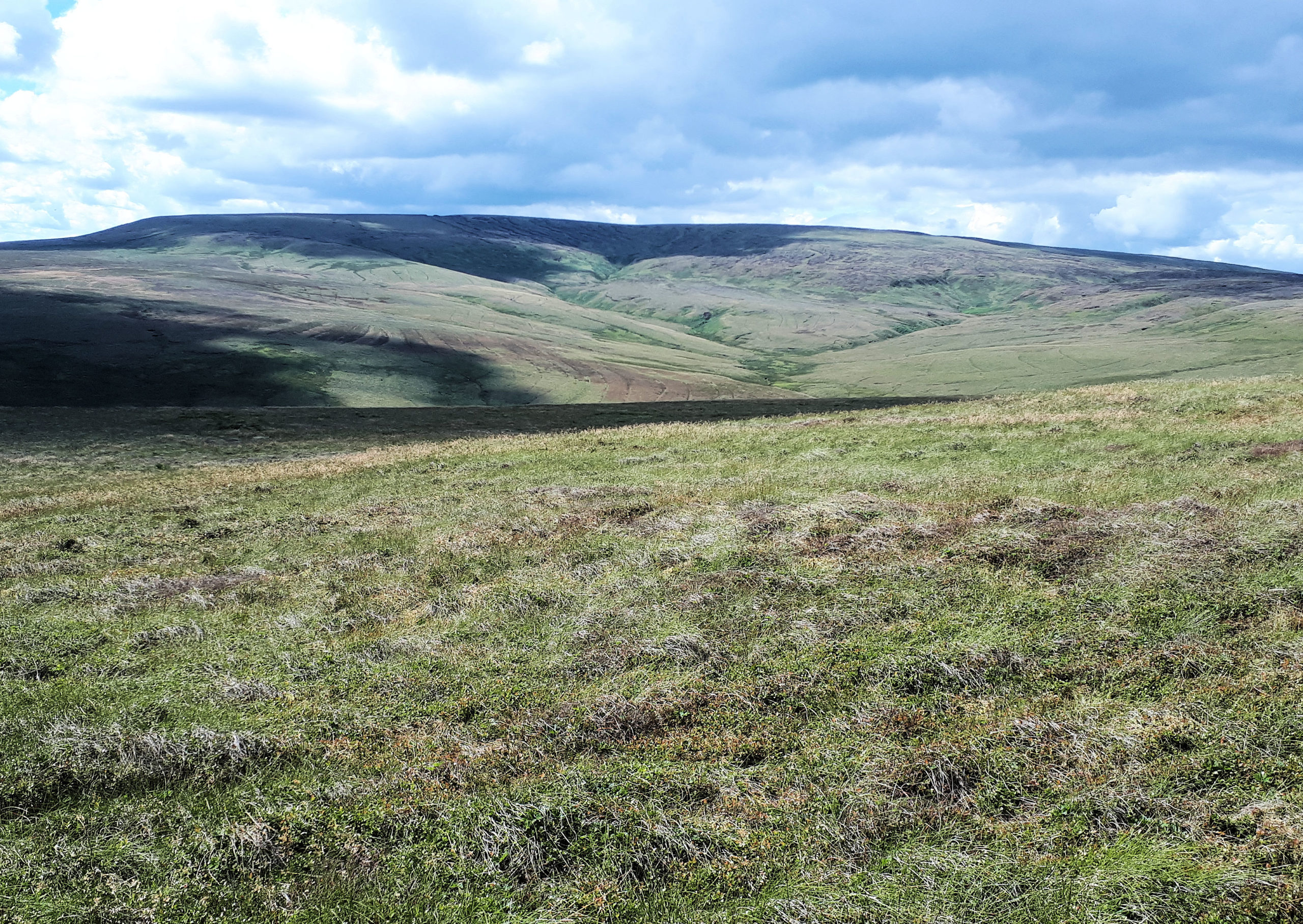

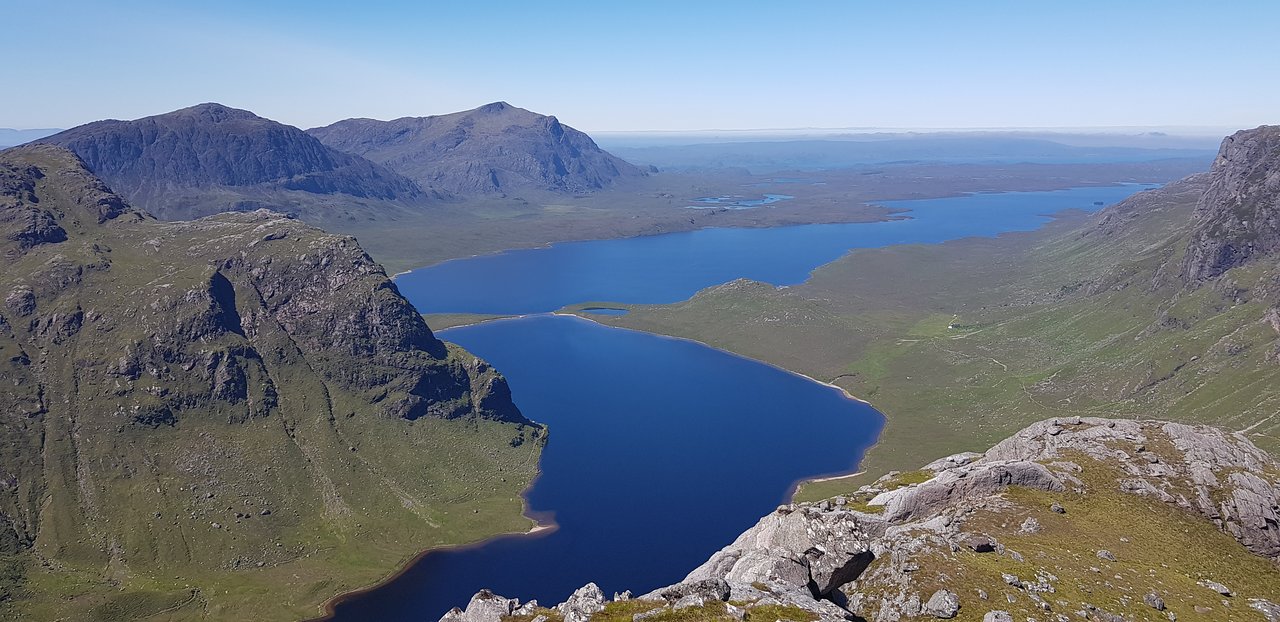

- There are of course areas that feel like wilderness due to inaccessibility, naturalness (eg self seeded vegetation and absence of human structures) or lack of settlement, such as those found in North Pennines, Lake District, Scottish Highlands and mid Wales.
- If you can see buildings, tilled soil, grass or coniferous or deciduous trees you are not remote – for that you tend to need to venture into scrubland, which usually means mountains or moors.
- Remoteness from population in Britain only begins as you move north west, and if you are within 50 miles of the M25 you are as unremote as it is possible to be, although East Anglia is as good as the rest of Wales and Scotland.
- To escape roads and signs of civilisation it helps to be near the coast but your best bets are in Scotland, mid Wales, North West England and Dartmoor.
- England is rammed with roads and has only a few national parks where you could get an hour’s hike from a road. Much of Wales looks natural but is really just a stroll from roads and villages. The biggest gaps between roads are around mountains and are about 5-10km as the crow flies, meaning you are as little as 2.5-5km walk from the nearest road. Scotland has some slightly more remote mountains but never more than a few hours hike, and you have to cross a wall of roads across Edinburgh and Glasgow to get into Scotland, and Wales is similarly fenced in by a mass of roads.
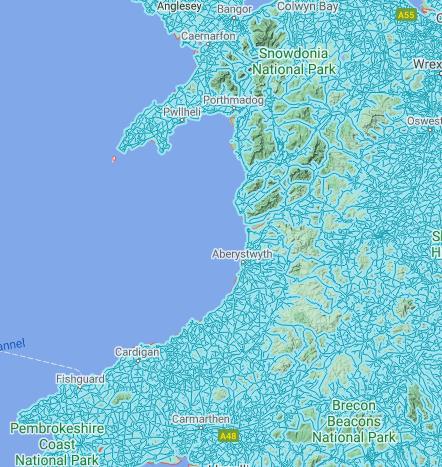

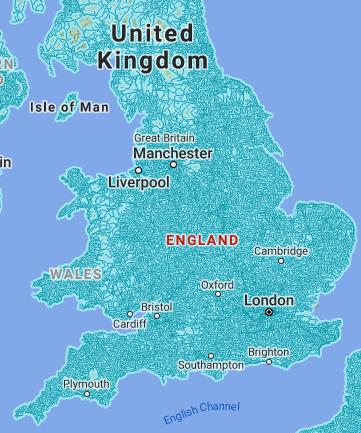
- You are never more than a day’s walk over rough ground from population or roads.
- As at 2018, 83% of the UK lived in urban areas, so all rocking up in rural areas and expecting spare housing or even not to be noticed in the woods is impossible. So you cannot be too far to find, and thus have to concentrate on being too camouflaged to find or too discrete to notice or too secure to be invaded.
- For example, Essex is 60% denser than national average yet is a rural county with 72% of land used for agriculture, so if all the townies headed for the hills it would be like a rave on a farm, with 560 people per square kilometre of field, each having a plot 42 metres square – like the length of a typical early 20th century terrace garden, or one sixth of a football pitch each – hardly invisible.
- In England average population density in 2021 was 434/km2 or three people per football pitch side area, so 2,304 square metres each if they were to spread out, but again, if they all headed for the countryside then, although city dwellers would have more space than they do now, it would be more like 1,000 square metres each or a square plot 100′ x 100′. So you can’t all hide in the UK. If you want space you might want to head for Rutland where it is some 600 times less dense than Tower Hamlets with one resident per football pitch sized area. Or even better or worse, get a boat to the Isles of Scilly where all 2,100 of the the locals will notice you but it is even more spacious than Rutland. Another option is the City of London which is second only to the Scilly Isles for spaciousness as hardly anyone lives there, so taking over offices may be worth considering if you want to stay in London after a disaster until food and water runs out.
Hunkering down
- Ideally you want everyone near you prepped so you can bring them in with you and leave their homes empty as a perimeter.
- Get out of areas with hardcore religion, lots of youngsters with no resources or slums with transient, lazy poor types who will create chaos. If you must stay urban then look for low crime skilled Anglophonic healthy unpolluted areas with education and entrepreneurs who can trade or think their way out trouble, but do not assume they do not have links with crime lords or government (or government with gangsters). Contrary to the advice of many preppers to stay urban for resources, research into civil war shows that tends to kill you due to choosing the wrong people as your future.
- Stay away from, or plan for, chemical plants and nuclear power stations. Stay away from targets like ports, major roads and airports.
- From research in Chechnya we know that if you end up fighting an urban war then half will end up depressed and a quarter psychotic, typically weak, worried or warlike. And that is without knowing your world has ended in a global catastrophe.
- Your so-called friends may feel like allies as they cooperate while they are safe, but once there are not enough resources for all of you then you will realise they were only ever aides, who will eventually transition through neutral, to becomes obstacles by siphoning off your resources and ultimately going hostile when they decide to at least gradually phase you out. Without security you do not have shelter, medicine, food or water – somebody more aggressive does, or will.
- Learn from the art of war the importance of strength, speed and secrecy. Do not get tired, do not let anyone know what you have, but be able to repel anyone who comes after you anyway, and do not let them know you have that strength and thus something worth protecting unless they already know what you have or are coming on spec anyway, in which case still have more strength than you reveal.
- Choose a building that is reinforced with a concealed escape route.
- Ideally:
- barricade ground floor openings,
- cover higher openings to stop items being lobbed in,
- fireproof wooden floors with at least a couple of inches of sand,
- dot fire blankets and buckets of water around for firefighting,
- hide antennas.
- An army would smash, shoot or blow their way in, but more realistically you could stop most looters by reinforcing against normal tools, bricks and arson. Whilst reinforcing against a civil war scenario like guns, grenades and gas is feasible, it is expensive, destructive and probably too late to start once trouble flares. Remember, in urban environments you cannot see or radio far, and attackers can sneak from all directions.
- If concealment is the priority then choose somewhere hidden, away from lines of drift, where you can observe and escape from, sheltered and with communications ability.
Evacuation tips:
- Evacuation may include schools, even if it is just your decision to get your family home or far away. You should agree in advance who will collect the kids.
- For a disaster that does not take down the grid but forces you out of town, what happens to your job, education and healthcare?
- In war, tensions may have risen recently, meaning Brit Cits were repatriated creating a housing crisis affecting your ability to move home.
- In evacuation, authorities may try to force you out of your car to prevent congestion or to take strangers to fill empty seats.
- In a mass health or injury event, ambulances will no longer transfer you for appointments so you will go without specialist treatment. If a hospital is evacuated, it can take two years to recover, even if society continues business as usual; that is how vulnerable they are.
- If a school is evacuated, teachers will keep children with them rather than send them home so you need to find out where and get there.
- If a prison is evacuated, it is to the courtyard and if that is not viable prisoners will either be moved by NOMS under outsourced contracts or if NOMS are incapacitated then presumably released. Immigration detention centres rely on the Prison Service to help in an emergency, which may not be available, meaning they are more likely to open the gates.
- If a zoo is evacuated then non-native animals have to be locked in by law – which would appear to cover tigers etc.
- If the council evacuate your home it will probably be to a hall such as a school or leisure centre for which your bug out bag (‘BOB’) will be handy, especially if topped up with ready to eat food, a sleeping bag and mat (and blowup pillow such as a ziplok), toiletries and change of clothes, as these would take time to arrive even if a calloff contract was invoked and could deliver. Apart from food and bedding, the same applies if you can make it to a distant friend or relative or hotel.
- History shows that council evacuations are chaotic and even moving the equivalent of just one street will be messy. Look at what happened when Grenfell tower had to be rehoused after it turned into a funeral pyre and similar fire risk towers emptied as a precaution. You are chucked on a gym floor in the clothes you stand up on the first night and then you might get a B&B in subsequent days.
- The Housing Acts require councils to house their whole district if made homeless for more than a few days by disaster, so they would have to use their contingency fund to send residents to other districts and hope government reimburses them. Council have a power to provide shelter in the short term, which mean rest centres or hotels.
- In a local evacuation councils may try to get wardens to patrol the district to persuade you to leave your home unguarded, but they are unarmed and currently have no powers beyond ticketing for dropping chewing gum etc.
- Your prepper binder should include your evacuation plan.
Bug in or out?
- You will probably bug in as that is where you and your gear, job, contacts and resources are, at least until it becomes obvious the disaster warrants a bugout. Depending on your resources and attitude to risk you should prepare to hunker down for two weeks to two years. When and where you go depends on the scenario. The more widespread the disaster, the further and earlier you must go to escape it before it’s too late.
- Urban Prepper suggests:
- bug in for power / internet down, solar flare / volcano / heatwave / tsunami / storm / ELE, civil unrest / martial law / EMP / war, economic collapse, plague / famine,
- bug out for fire / wildfire, gas / chemical / radiological / sewage leak, earthquake / flood, societal breakdown.
- Consider staying put for regional scenarios that won’t be better as far as you can travel in time. Consider evacuating for local scenarios like fire, leaks and local weather and unrest such as unrest flood or riots. Civil unrest (before roadblocks) and disease probably bring forward time to leave urban areas. Roughly speaking, all that will chase you out of your home if it is in one piece is war, pollution, water and fire.
- Below is a suggested starting point for the above personal and national risks:
| Bug in | Bug out |
| Lose income / savings / job | Lose relationship, unsafe to stay |
| Lose relationship, safe to stay | War, live near targets |
| Hacked | Riots, live near flashpoints |
| Strikes | Illness, need care elsewhere |
| War, live far from targets | Pollution, longer term / on way |
| Terror | Flood, deep |
| Riots, live far from flashpoints | Fire |
| Illness, can care at home | Home destroyed, unless elsewhere worse |
| Pollution, short-lived / already arrived | |
| Snow | |
| Space weather | |
| Flood, shallow | |
| Heatwave | |
| Volcano, unless time & need to escape lava | |
| Drought, unless need water elsewhere | |
| Tsunami / dam burst, unless time & need to escape | |
| Power cut | |
| Transport down | |
| Goods shortage / sabotage | |
| Service failure | |
| Utilities down | |
| Leaks, NBC short-lived / already arrived | |
| Unrest abroad | |
| Satellites down | |
| Comms down | |
| Banking down | |
| Animal disease, unless local pandemic can jump to man | |
| Shipping disaster | |
| Transport crash | |
| Plant pest | |
| Pandemic | |
| Wildfire, unless time & need to escape | |
| Famine | |
| Earthquake, unless time & need to escape |
- Either way, make not just a folder of action plans for scenarios, but plan in advance the bug out trigger, to avoid argument, panic or complacency.
 Limey Prepper - UK Preppers Handbook